Teach in China · Interactive guide
How to Get a Good Teaching Job in China Without Getting Screwed Over
A practical guide for first-time teachers. It helps you choose a city, a school and an offer that fit the life you actually want.
A look inside
What’s inside the guide
Practical chapters written from six teaching jobs in China, checklists to work through before you say yes to anything, and an offer calculator that shows what a job really pays over a year.
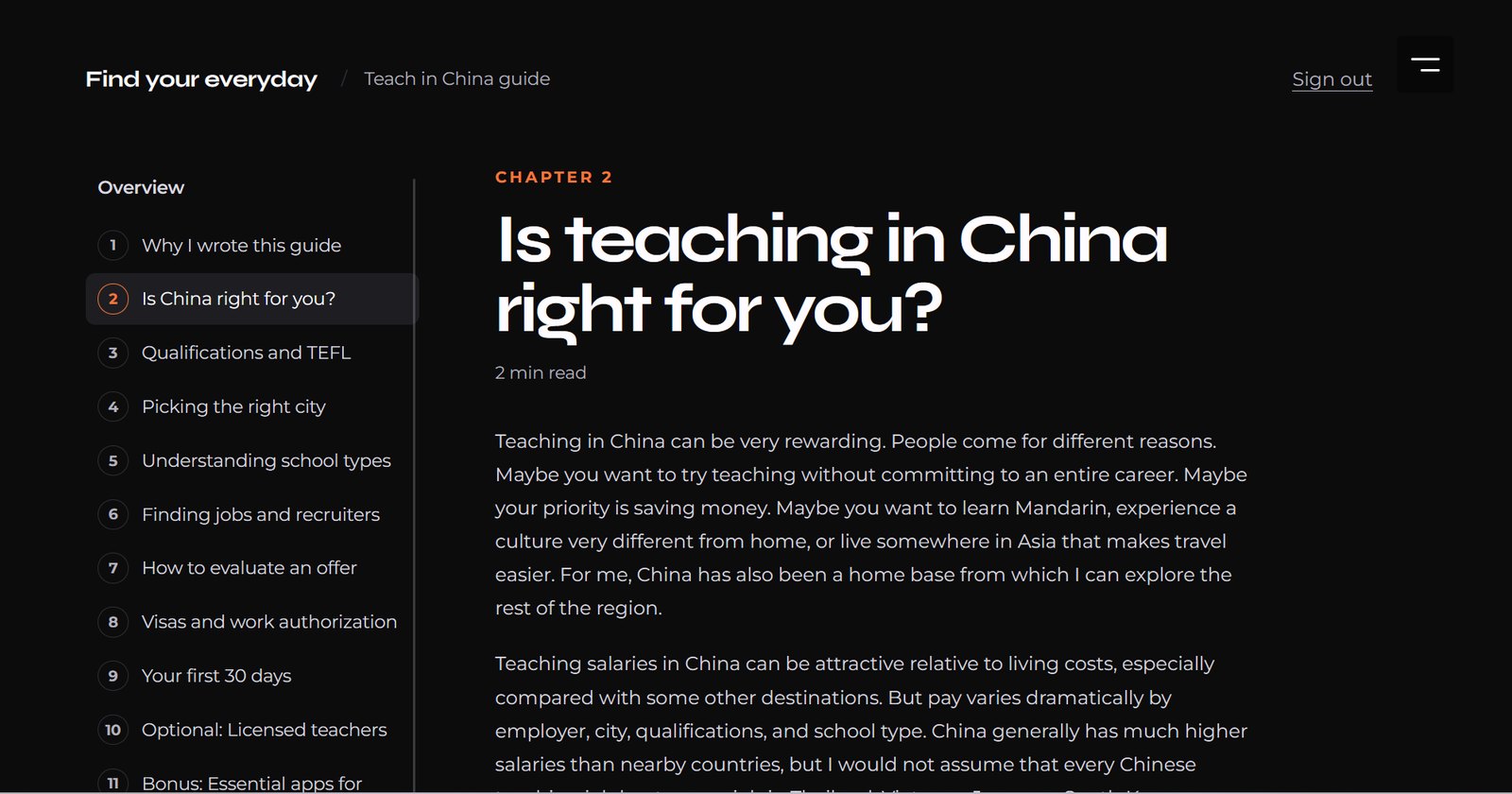
Chapter 2, as it looks in the guide. Read it free below.
Offer calculator
An example result
Here’s the calculator run on my 2025 Chengdu kindergarten contract (chapter 4): ¥22,500 after tax a month, with 2 holiday months paid at ¥10,000, and housing not included. You enter five things from your offer; the calculator fills in typical rent and living costs for the city.
Example only
- Estimated monthly living costs
- ¥6,600
- Left in a normal salary month
- ¥15,900
- Annual income
- ¥245,000
- Estimated annual savings
- ¥165,800
- Average savings per month
- ¥13,817
Rent about ¥3,400 + other costs about ¥3,200
Take-home pay minus living costs
10 months at ¥22,500 + 2 months of holidays at ¥10,000
After about ¥79,200 of living costs over 12 months
Annual savings ÷ 12, so lower-paid holiday months count
In a holiday month you’d be left with ¥3,400, because your costs carry on while your pay drops.
These are estimates based on city averages. Your real costs can be quite a bit higher or lower depending on your spending habits, apartment size and neighborhood, how often you eat out, travel and go out, and the exchange rate if you send money home.
Chengdu: rent of about ¥3,400 is the local average for a one-bedroom (about ¥2,400, between roughly ¥1,700 further out and ¥3,100 in the centre) plus ¥1,000, because foreigners usually rent nearer the centre and pay more than local averages. Other costs are an average single person’s monthly spending. Source: Numbeo, read 24 October 2026. Tax isn’t estimated: these figures assume the salary you entered is after tax.
Notice the gap: ¥22,500 a month in term time, but ¥20,417 a month averaged over the year.
Who it helps
For your first teaching job in China
Finding a job in China is not the same as finding a GOOD job in China. Two jobs with the same title in the same city can have very different working conditions. This guide helps you ask better questions before you leave home, so you understand what you’re agreeing to.
Decisions it helps you make
- Whether teaching in China fits your reasons for going, and your deal-breakers
- Which city fits the everyday life you want
- Which kind of school suits you: training center, kindergarten, public, private/bilingual or international
- How to work with recruiters, and who will actually employ you
- Whether an offer is worth accepting: time off, holiday pay, campus location, workload and exit terms
- What to confirm about work authorization before you fly
- What to ask your school to help with in your first 30 days

Who wrote it
Written from six teaching jobs in China
- Years in China
- 5+
- Cities lived in
- 3
- Teaching jobs
- 6
What’s included
Read it, use it, run the numbers
- 9+2
Interactive chapters
9 chapters, plus an optional note for licensed teachers and a bonus Essential Apps for China guide. Read on any device; your progress is saved as you go.
- ✓
Practical checklists
Questions to put to recruiters, schools and HR, an offer-check, and a “Try this” exercise at the end of most chapters. Tick them off as you go.
- ¥
Offer calculator
Enter the city, school type, take-home pay, holidays and housing from an offer. See estimated living costs, what’s left each month, your yearly income and what you’d roughly save.
Chapter previews
What’s inside
- 1
Why I wrote this guide
Five-plus years, three cities and six teaching jobs in China, and why finding a job here is not the same as finding a good one.
- 2
Is teaching in China right for you?
Why people come, the trade-offs nobody puts in the job ad, and why “kindergarten ESL teacher in Shanghai” tells you almost nothing.
Free to read below - 3
Qualifications and getting started
Whether you can be hired legally, what a TEFL certificate is (and isn’t), and how to treat nationality and experience requirements in job ads.
- 4
Choosing the right city
Matching the city to your reason for coming, what my own rent and pay looked like in Shanghai and Chengdu, and why the neighborhood matters as much as the city.
- 5
Understanding teaching jobs in China
Training centers, kindergartens, public schools, private and bilingual schools, and international schools: what each tends to involve and what to ask.
- 6
Where and how to find jobs
What a recruiter actually does (and doesn’t), introduction versus employment agency, where I would search, and how to prepare for the interview.
- 7
Questions to ask before accepting a job
Time off, the exact campus location, resignation terms, what “salary and benefits” really means, who you’ll work with, and a walk-through of a normal day.
- 8
Visas and work permits
Recognizing the correct kind of arrangement, the warning sign to walk away from, and the questions to put to HR before you fly.
- 9
Your first 30 days in China
Paperwork, bank account, medical check, phone number, apartment and apps, and what to ask your school to help with before you arrive.
- +
OptionalAlready a licensed teacher?
If you hold a state teaching license, QTS or another recognized credential, your job search may look different.
- +
BonusEssential apps for China
The 14 apps that make everyday life work: paying, eating, getting around and translating. Also available as a free PDF.
Free PDF download
Free sample chapter
Chapter 2 · 2 min read
Is teaching in China right for you?
Teaching in China can be very rewarding. People come for different reasons. Maybe you want to try teaching without committing to an entire career. Maybe your priority is saving money. Maybe you want to learn Mandarin, experience a culture very different from home, or live somewhere in Asia that makes travel easier. For me, China has also been a home base from which I can explore the rest of the region.
Teaching salaries in China can be attractive relative to living costs, especially compared with some other destinations. But pay varies dramatically by employer, city, qualifications, and school type. China generally has much higher salaries than nearby countries, but I would not assume that every Chinese teaching job beats every job in Thailand, Vietnam, Japan, or South Korea. Compare actual written offers, living costs, and the number of paid months.
The trade-offs
You may be dealing with language barriers, unfamiliar apps, different expectations at work, and a management culture you are not used to. Some jobs are demanding. Some schools expect meetings, parent communication, classroom preparation, reports, summer camps, or other duties that are not obvious when you see the job advertisement. That can change the job completely.
There is a reason the salaries are so high.
Living here can be convenient once you understand the systems. Before that, even setting up a bank account or getting delivery to your apartment can be frustrating. You can learn it, but do not confuse “I can adapt” with “I should accept any conditions.”
Two schools, two completely different lives
Imagine two schools near the same metro station in Shanghai.
School A
Good take-home pay, meaningful time off, supportive management, a teaching approach that follows children’s interests, and little work to take home.
School B
Lower pay, a required summer camp, a day spent drilling vocabulary through repetition, and substantial additional duties.
Same city. Same job title. Completely different day-to-day life.
Those are illustrative contrasting scenarios, not two specific offers I am verifying here. The point is that “kindergarten ESL teacher in Shanghai” tells you almost nothing about whether the job is right for you.
I have heard people talk about living in China as the best decision they made, while someone else who lived in the same city hated the experience. The city can matter, but so can the school, your commute, your colleagues, and how much control you have over your working day.
Money-back guarantee
Not satisfied? Get your money back within 14 days.
If the guide isn’t what you needed, email me within 14 days of buying and I’ll refund you in full.
Get the guide
How to Get a Good Teaching Job in China Without Getting Screwed Over
Checkout was cancelled. You haven’t been charged.
The guide isn’t available to buy right now. You haven’t been charged.
We couldn’t open checkout just now. Please try again in a minute. You haven’t been charged.
$49.99
Single payment. Includes all chapters, checklists and the offer calculator.
Payment is handled by Stripe. After paying, we email you a sign-in link to open the guide. 14-day money-back guarantee. By buying, you agree to the Terms of Service (including the refund policy) and Privacy Policy.
FAQ
Questions
Who is this for?
People considering their first ESL teaching job in China. If you already hold a recognized teaching license or QTS, your recruitment path is different; the guide includes a short optional chapter for you.
Is this helpful if I teach another subject?
Absolutely. Nothing in the guide is ESL-only: choosing a city and school, working with recruiters, reading an offer, visas and your first 30 days apply to any foreign teacher in China. My own background is ESL and kindergarten, so that’s where my personal examples come from.
Is this legal or visa advice?
No. It explains what to ask and what to get in writing. Requirements differ by role, nationality, employer and location, so confirm them with your employer and the responsible authorities.
How do I open the guide after buying?
We email a sign-in link to the address you use at checkout. It opens the guide in your browser, with no password. You can request a new link any time, on any device, from “Access your guide”.
Is it a subscription?
No. It’s a single payment, handled by Stripe.
Does it include job listings or recruiter introductions?
No. It shows you where to look and how to check a school, a recruiter and an offer yourself. No recruiter, job-board or apartment-agent service is included.
Does the calculator work out tax?
No. You enter take-home (after-tax) pay, which is the figure to ask every school for. The calculator then works out your year from that.